From Physical Games to Digital Experiences
Explore how arcade machines, home consoles and digital adaptations changed the setting of play while preserving many familiar game design principles.
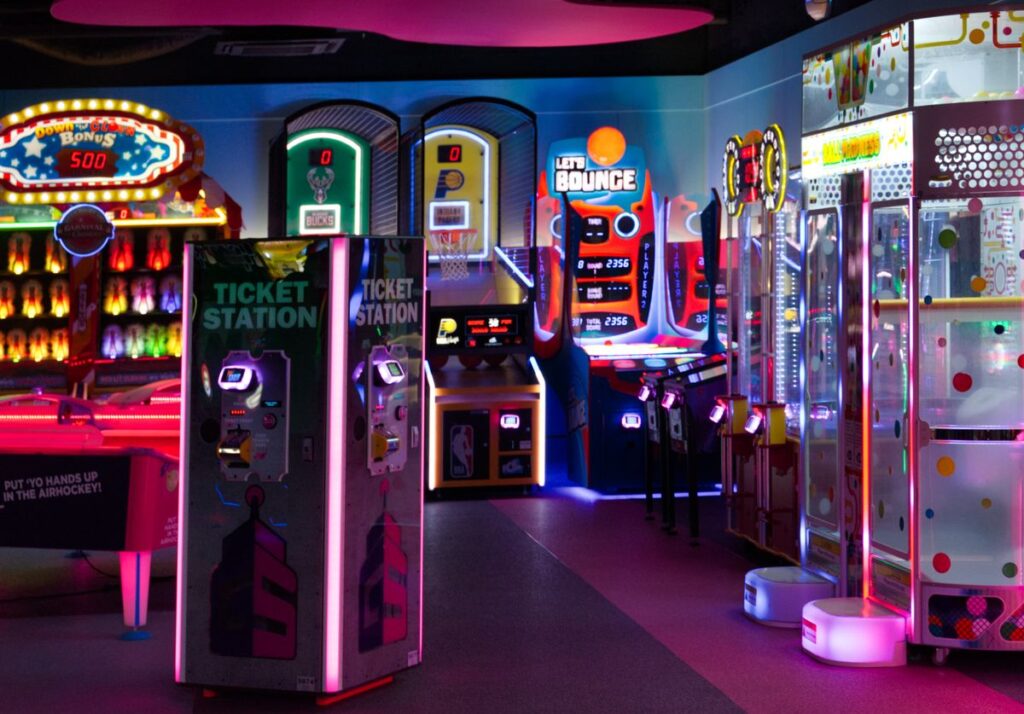 Colourful arcade machines in an indoor entertainment centre · Pexels contributor · Source photograph · Pexels License (display sizes may be cropped or resized)
Walk into almost any craft brewery taproom on a weeknight and you’ll find a stack of board games by the bar. A battered Scrabble box. A Jenga tower leaning against the wall. A few decks of cards with sticky corners. In some places there’s a row of old arcade machines blinking in a corner, too. Nobody comes for the games, exactly. But they keep people at the table long after the first pint.
That mix of the physical and the electronic says a lot about how play has changed. A board game shows you its rules through objects. The squares tell you where pieces can move. A deck of cards holds every possible action in your hand. A chalk line on a playground marks where the game stops and the rest of the world begins. Video games carry the same ideas, but through screens, images and software. That opens up possibilities that would be hard or impossible to build out of cardboard and plastic.
Where we play keeps moving
The earliest commercial video games lived in public places. Bars, bowling alleys and amusement halls were where most people first met them. Atari’s first Pong cabinet was installed in a Sunnyvale tavern in 1972 and seemed to break down within days. When engineer Al Alcorn came to fix it, he found the machine was simply so full of quarters it couldn’t take any more. The Computer History Museum tells the story in its look back at 50 years of Pong.
Then games came home. The Magnavox Odyssey arrived in 1972, and by the end of the decade consoles were plugged into family televisions across the country. Play moved from the bar to the living room. Later still, handheld devices like Nintendo’s Game Boy in 1989 let people take games on the bus, to school or into the back of the car on a long drive. The Strong National Museum of Play’s video game timeline is a good way to see how those systems followed each other.
Each setting changed the experience. In an arcade, playing was a bit of a performance, with friends and strangers watching over your shoulder. At home, it became more private. On a handheld, it fit into the short gaps of a day. The hardware mattered, of course. But so did the room you were sitting in and who was sitting beside you.
Letting the software keep track
One of the big advantages of a screen version is that it can take care of the bookkeeping. It can enforce whose turn it is, keep score and highlight which moves are allowed. Anyone who has played a long board game with lots of tokens and tracking sheets knows how welcome that can be. Digital editions of games like Catan or Ticket to Ride let people play a full game in half the time, because nobody has to count resources or check the rulebook.
The best interfaces go further and teach the rules as you play. Try an illegal move and the game shows you why it doesn’t work. You learn by doing, without having to memorise a manual first.
There’s a catch, though. Automation can hide what’s actually going on. Around a real table, players learn by moving pieces, counting out loud and arguing about whether that last move was allowed. On a screen, a player might simply see a greyed-out button and have no idea why it’s greyed out. Good design should explain the reason. “You can’t build there because you need a road first” teaches far more than a button that silently refuses to work.
Homebrewers will recognise that tension immediately. An automated brewing machine can handle temperatures, timings and transfers far more precisely than most people can by hand. That’s a gift on a busy weekend. But a brewer who has only ever pressed start may never learn why a mash temperature matters or what happens when the boil runs long. The machine does the work. Understanding still has to come from somewhere. Games are no different. When the software does everything, the player can end up winning without really knowing how.
New ways to take part
Software can do things physical games can’t. It can build worlds that change every time you play. It can link friends on opposite sides of the world so they can cooperate on the same puzzle. It can adjust the difficulty for a beginner or a seasoned player, and add options like larger text, colour-blind modes or one-handed controls.
Those features can open play to people who might otherwise be left out. A friend with limited hand movement might struggle to shuffle and deal a deck of cards, but have no trouble tapping a screen. Someone who moved abroad can still join the family’s weekly game night from another time zone.
None of that makes screen versions automatically better, though. Plenty of electronic adaptations feel thinner than the originals. Chess is a good example of both sides at once. Online chess has introduced millions of new players to the game and lets anyone find an opponent at three in the morning. Yet many of those same players still prefer the weight of real pieces and the quiet of a real board when they can get one.
When the board and the app share a table
Some of the most interesting games today refuse to pick a side. They’re board games that come with an app. Mansions of Madness, a horror game first released in 2011, came back in a second edition in 2016 that handed the role of game master to a free companion app. The app reveals rooms, controls the monsters and keeps the story moving, while players still push real figures around a real map. Chronicles of Crime, a detective game, has players scan small codes on cardboard cards with a phone to question suspects and search crime scenes.
These hybrids try to keep the best of both. The software handles the fiddly parts, like hidden information, timers and branching storylines. The table keeps the conversation, the physical pieces and the moment when everyone leans in to see what happens next.
They aren’t for everyone. Some players find a phone on the table breaks the spell. Others love not needing one person to sit out as referee. Either way, they show how loose the line between physical and electronic play has become. For a homebrew club looking for something to do after a tasting, a hybrid game can be a good middle ground between a deck of cards and a console.
Where taprooms come in
Brewery taprooms have become an interesting meeting point for all of this. Many keep shelves of board games for customers. Some run trivia nights through an app on a big screen, with teams answering on their phones. A few have gone further and filled a back room with restored arcade cabinets, which turned into a whole trend of so-called barcades in the 2000s and 2010s.
What’s striking is that people move happily between all of them. A group might start with a card game, switch to a quiz on their phones, and end the night on a two-player arcade machine. Nobody seems to think of these as competing formats. They’re just different ways of having fun together over a drink.
That’s worth remembering for anyone who worries that screens are killing traditional play. In the places where people actually gather, the old and the new tend to sit side by side.
Different formats, different strengths
Physical games bring touch, presence and conversation. You can see your opponent’s face when they realise you’ve blocked their move. You can pass the dice, knock over the tower or slap down the winning card. Those moments are hard to reproduce on a screen.
A digital game, on the other hand, brings convenience and flexibility. It can be set up in seconds, played with someone far away, and adjusted to suit the player. It can keep track of complicated rules so people can focus on decisions instead of bookkeeping.
Plenty of people enjoy both, for different reasons and at different times. A quick puzzle on the phone during a lunch break. A long board game with friends on a Saturday afternoon. A retro arcade machine at the local taproom on a Friday night.
Electronic entertainment isn’t the end of traditional play. It’s one more way of expressing something people have always enjoyed, which is a set of rules, a bit of challenge and a reason to spend time with others.